Renting a tour guide system: how to choose the right set for your group
A tour guide system is a wireless set consisting of a transmitter for the speaker and receivers with earphones or headsets for the group. When renting a tour guide system, you generally make your choice based on four factors: the number of participants, the number of languages or groups, the environment you are walking through, and the duration of the program. For tours of up to approximately 250 people, there are systems that work seamlessly, even in factory halls and museums.
Tours rarely fail because of the content. They fail because of intelligibility. A guide speaking over machine noise, a group crowding into a semicircle around the speaker, stragglers missing half the information: these are classic situations during company visits, factory tours, and excursions around conferences. A tour guide system solves this by sending the speaker's audio directly to the ear of every participant.
In over sixty years of AV technology, we at IFS Audiovisueel have deployed these sets in courts, ministries, museums, production halls, outdoors, and conference centers. The technology is mature, but the choice between systems and configurations determines whether a tour runs smoothly. Below is what you should look out for in practice.
What exactly is a tour guide system?
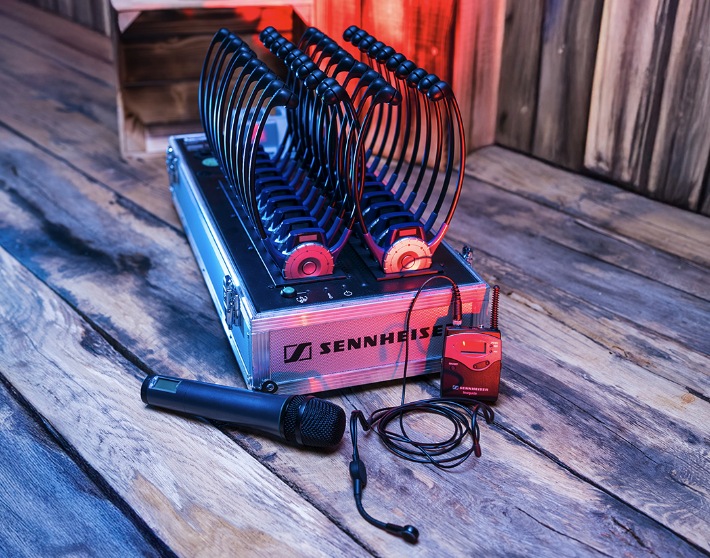
A tour guide system, also known as a whisper set or tour system, consists of three components. The speaker wears a transmitter with a headset microphone or a handheld microphone. Each participant receives a receiver with an earphone, ear hook, or stethoscope headset. In addition, it always includes a charging case, which charges the equipment while also serving as a transport case.
The connection is now digital. This means no static, no interference from other wireless equipment in the building, and, with most systems, encrypted audio. The latter is not a luxury when touring a production site, a laboratory, or a secure environment.
What do you use a tour guide system for?
The applications are more diverse than the name suggests.
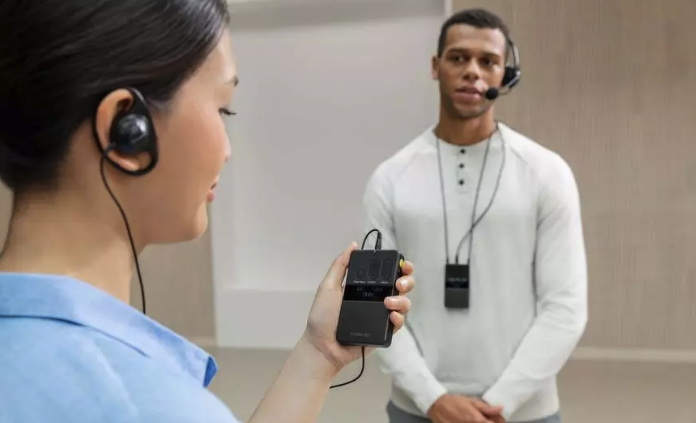
Tours and company visits. The classic application: a guide walking and talking, a group following along spread out. Participants no longer need to huddle together and can look around calmly while they listen.
Whisper interpretation. An interpreter translates quietly into the transmitter, and the non-native speaking participants listen via their receivers. This is the lightest form of simultaneous interpretation and does not require an interpreter booth. Useful for work visits, small delegations, and bilateral meetings.
On-site training and instructions. When providing safety instructions in a noisy environment, a whisper set is often the only way to truly reach everyone.
Multilingual meetings without a fixed setup. Some systems support multiple channels simultaneously, allowing you to distribute different languages within the same room.
Accessibility. Participants with hearing impairments can receive audio directly in their ear, without interference from reverberation or background noise. For blind and visually impaired visitors, the same system can broadcast audio description. See also our blog about induction loops and hearing loops.
The benefits at a glance
- Everyone can hear the speaker, even at the back of the group and in noisy environments.
- The guide does not need to shout, which reduces vocal strain and minimizes disturbance to other visitors.
- Groups can be larger without any loss in quality.
- Participants can move freely and look around without losing sight of the speaker.
- Multilingualism is possible without booths, stands, or fixed setups.
- The sets are lightweight, quick to distribute, and operational within minutes.

Renting a tour guide system: what should you look for?
1. Number of participants and number of groups
First, determine how many receivers you need and whether the group will split into subgroups. Two groups walking through the same building at the same time each require their own channel. Always include a few spare receivers, especially for groups of more than fifty people.
2. Number of channels and languages
This is where systems differ the most. For a single guide in one language, a basic set will suffice. As soon as you add interpreters or run multiple routes simultaneously, the number of available channels becomes the deciding factor for what is possible.
3. The environment
Concrete, steel structures, elevator shafts, and thick walls dampen the signal. Factory halls are also full of other wireless equipment. In such environments, a system with automatic frequency management is clearly preferred. When in doubt, we perform an on-site test beforehand.
4. Duration of the program
A one-hour tour has different requirements than a conference day with excursions from morning to evening. Pay attention to the battery life of the receivers and the availability of a charging case so you can recharge between sessions.
5. Type of earpiece and hygiene
With large groups and varying users, this is a real consideration. Stethosets are comfortable and stay in place well, while individual earbuds are more hygienic for each participant. We supply the sets cleaned and work with disposable earbuds where necessary.
6. Integration with room audio
Does the tour start or end in a room? It is convenient if the tour guide system can pick up the sound from the room's audio system so that participants do not have to take off their receivers. This requires an audio connection that has been set up in advance.
Sennheiser Tourguide 2020-D or Televic Unite?
Two systems are most common in professional rentals. Both are excellent, but they are not interchangeable.
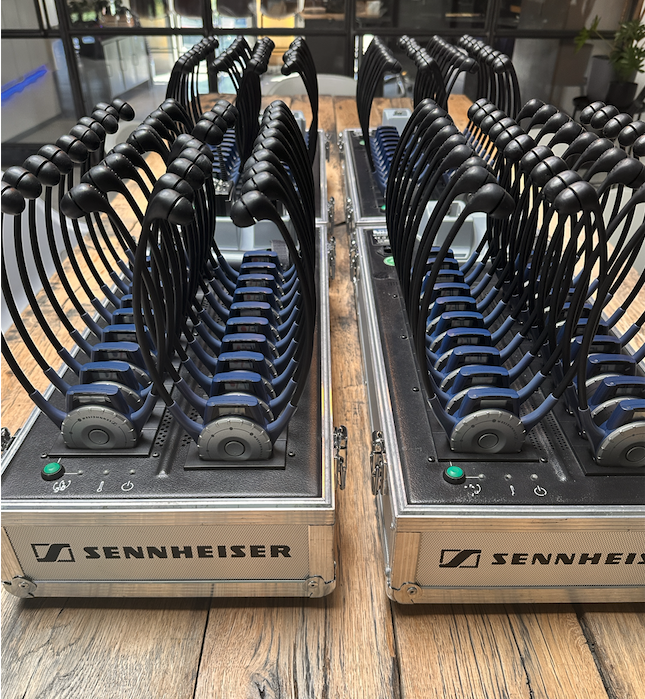
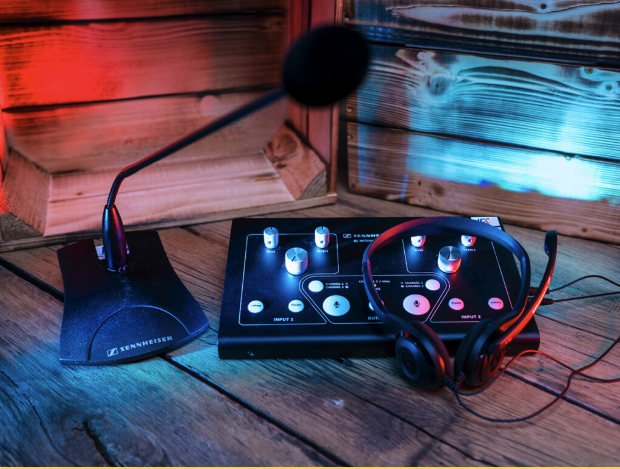
Sennheiser Tourguide 2020-D is the workhorse for guided tours. The system operates in Europe within the 863 to 865 MHz band and offers six channels in tour mode and eight in conference mode. The HDE 2020-D-II stethoset receiver weighs approximately 73 grams and runs for up to eight hours on a single charge. The receiver switches off automatically as soon as a participant takes it off, which saves a significant amount of battery life in practice. The audio range is 100 to 7,000 Hz, which is more than sufficient for speech. Key strengths: simplicity, low weight, and rapid distribution to large groups.
Televic Unite is a broader platform. It operates on the license-free DECT standard with automatic frequency management, reaches up to 300 meters in open space, and supports up to 32 parallel groups or languages. The audio bandwidth is 14 kHz, the audio is encrypted with AES-256, and three speakers can be active simultaneously within the same group. With the AP4 access point and a Dante interface, the system connects directly to room technology. Key strengths: multilingualism, security, and the combination of guided tours, presentations, and interpreter distribution in one system. We previously wrote an extensive blog post about it: Televic Unite as a single wireless system.
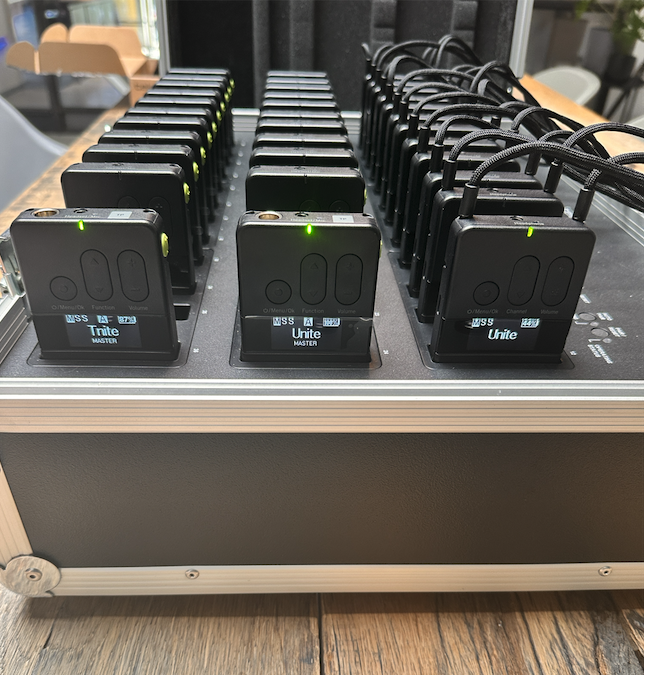
The rule of thumb we use: if it concerns a tour in one or two languages, the Sennheiser 2020-D is fast, lightweight, and more than adequate. If interpreters, multiple languages, sensitive information, or integration with conference technology are involved, then Televic Unite is the logical choice.
Practical experience
During international site visits, we often see the same combination: a plenary session in a room with interpreter booths, followed by a tour of the location. The pitfall is that both parts are procured separately, forcing participants to switch equipment halfway through, which causes the translation to drop out momentarily. By planning interpreter technology and the tour guide system as a single chain, the translation remains seamless from the room to the tour. This saves time, avoids confusion, and eliminates the need for extra explanations.
A second recurring point is distribution. Handing out a hundred receivers at the door takes time if no one is coordinating it. We always assign someone to handle this, including counting them upon return, so that no equipment goes missing at the end of the day.
In conclusion
Renting a tour guide system is a straightforward decision, provided you know in advance how many people will be joining, how many languages are involved, and what the environment is like. Those three answers determine the system. The rest is just logistics and proper support on the day itself.
Want to know more about the possibilities? Take a look at our page on interpreting and translation solutions or contact us for advice on the right configuration.
Frequently asked questions about tour guide systems
How many people can a tour guide system accommodate?At IFS Audiovisueel, we provide tour guide and whisper sets for up to 250 people. The number of receivers is usually not the limiting factor; the number of available channels is, especially when working with multiple groups or languages simultaneously.
What is the difference between a tour guide system and a whisper set?
In practice, they refer to the same thing. The term "whisper set" is used more often when an interpreter is listening and translating quietly, while "tour guide system" is used when a guide is leading a group. The equipment is identical.
What is the range of a tour guide system?
That depends on the system and the environment. Televic Unite reaches up to 300 meters in open space. Concrete, steel, and elevator shafts significantly reduce that range, so a preliminary test is advisable in a factory hall or underground space.
How long do the batteries last?
The Sennheiser HDE 2020-D-II receiver runs for up to eight hours on a single charge and switches off automatically as soon as it is taken off. For longer programs, we provide a charging case so you can recharge between sessions.
Can a tour guide system also be used for translation?
Yes. With multiple channels, each language can be broadcast on its own channel. For small groups, this is a fully-fledged alternative to interpreter booths, provided the interpreter can stand in a quiet location.