Hearing loops and induction loops: how do they work and where do you find them?
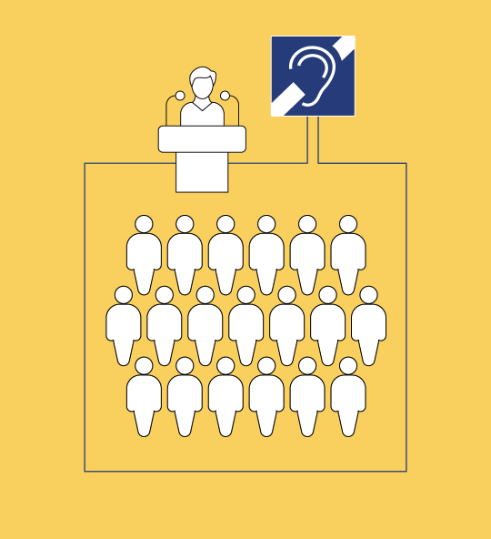
A hearing loop is a cable installed around a room that converts sound into a magnetic field. Hearing aids and cochlear implants equipped with a telecoil, also known as the T-setting, pick up this field directly and convert it back into sound. As a result, the listener hears only the speaker, without reverberation, background noise, or the distance from the microphone.
What exactly is a hearing loop?
The hearing loop is one of the oldest and most underrated pieces of technology in the audiovisual world. The principle dates back to the 1950s and still works today, even in rooms filled with modern wireless systems. In the Netherlands, you will encounter it under various names: ringleiding, hoorlus, inductielus, doventlus, or T-lus. In English, the same system is called a hearing loop or audio induction loop.
Why this technology remains relevant becomes clear when you look at the numbers. VeiligheidNL estimated that in 2020, approximately 1.2 million people in the Netherlands were living with hearing loss. That is roughly one in fifteen residents. In a conference room with 300 visitors, statistically speaking, about twenty people are missing part of the program without an assistive system. They rarely say so, as people are often reluctant to report their hearing loss to the organization.
How does a hearing loop work technically?
The operation can be explained in four steps.
The sound is first captured by the speaker's microphone or taken from the soundboard. This signal is then sent to a special hearing loop amplifier. This amplifier does not drive loudspeakers, but rather a loop of copper wire or copper tape installed under the floor, in the ceiling, or along the baseboard around the listening area.
An alternating current flows through this loop, following the shape of the audio signal. Any current flowing through a conductor generates a magnetic field, and this field fills the entire space within the loop. The visitor's hearing aid contains a small coil, the telecoil. As soon as the user switches their device to the T-setting, that coil picks up the magnetic field and converts it back into an electrical signal. The hearing aid then amplifies this according to the wearer's personal audiogram.
The result is that the hearing aid receives the speaker's microphone as the sound source instead of the room. Reverberation, murmurs, air conditioning, and shuffling chairs disappear from the signal. For someone with hearing loss, this is often the difference between just listening and truly participating.
The standard behind the technology: IEC 60118-4
Installing a hearing loop is not the same as making a hearing loop work. The international standard IEC 60118-4 defines when a system is actually usable. The most important requirements:
- A magnetic field strength of 400 mA/m at listening height, with a tolerance of 3 dB
- A frequency range of 100 Hz to 5 kHz, within 3 dB of the level at 1 kHz
- A uniform field, where the strength across the listening area does not deviate by more than 3 dB
- A background noise level that remains sufficiently low, in practice at least 32 dB below the signal
That last requirement is often the stumbling block in modern buildings. Dimmers, LED lighting, charging stations, and heavy power cables produce magnetic interference fields that a hearing aid picks up as a loud hum. An induction loop system that has been installed on paper but never tested can therefore be unusable, even though the sign at the entrance promises otherwise. Measuring with a field strength meter should be part of the commissioning process, not the complaint handling.
Where might you encounter an induction loop without realizing it?
The sign with the crossed-out ear and the letter T is displayed in far more places than most people realize.
A few real-world examples:
- Churches and places of worship. Historically the very first application and still the most densely populated category in the Netherlands.
- Theaters, concert halls, and cinemas. Often installed as a permanent system around the auditorium or per section.
- Service counters and desks. City halls, pharmacies, banks, hospitals, and station ticket counters usually work with a small counter loop of less than half a meter.
- Taxis and public transport. In London, counter loops in taxis are standard; in the Netherlands, they are found at information desks at stations and airports.
- Courthouses and council chambers. Where understanding every word carries legal weight, an assistive listening system is the rule rather than the exception.
- Meeting rooms and boardrooms. Increasingly included in permanent AV installations, especially in government and international organizations.
- Conference halls and event venues. These usually involve temporary systems that are set up for each event.
The induction loop is unobtrusive, and that is exactly the point. Visitors don't need to pick up a device, leave a deposit, or tell the front desk they have hearing loss. They simply switch their own hearing aid to the T-setting and listen in. This anonymity is one of the technology's greatest strengths, yet it is also the reason it is so often overlooked when setting up a room.

The personal induction loop: one neck loop per guest
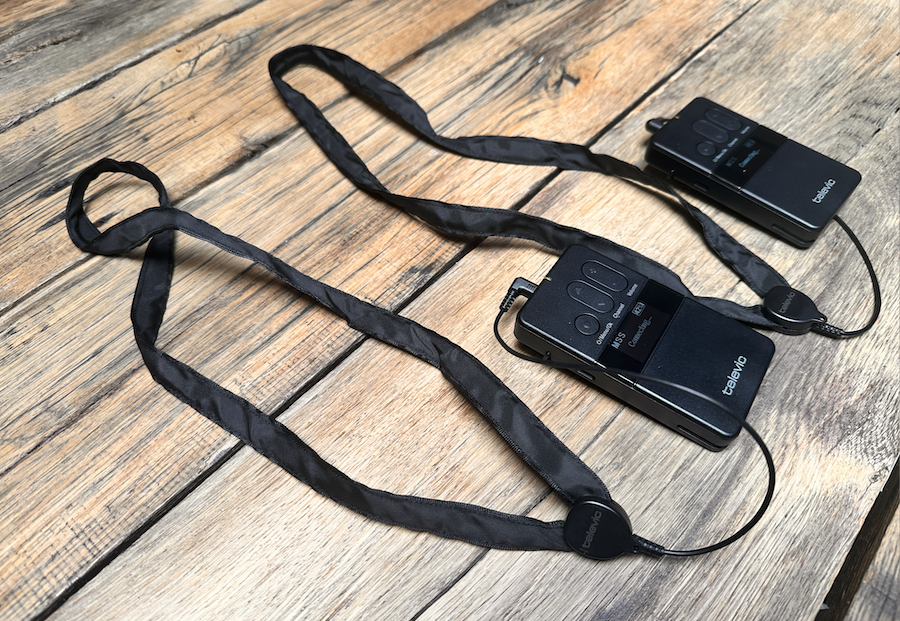
In addition to a fixed loop around a room, events are increasingly using personal induction loops. Guests receive a compact receiver at the desk with a neck loop—a thin cord worn like a necklace. The receiver picks up the sound wirelessly from a transmitter at the sound desk via radio frequency, infrared, or a network connection, and sends it to the neck loop. The neck loop then does exactly what a room loop does, just on a smaller scale: it generates a magnetic field that the hearing aid picks up in the T-setting.
For the listener, the effect is identical. For the organization, however, a lot changes. There is no need to lay hundreds of meters of copper tape under the carpet or along the walls, which is often the biggest obstacle in rented venues or historic buildings. Setup time is reduced from half a day to fifteen minutes.
The main advantage lies in the guest's freedom. With a fixed loop, there is a defined listening area, and those who want to hear well must sit within that zone. In practice, this often means the front rows or a specific section, separated from colleagues, delegations, and visibly set apart. With a neck loop, that restriction disappears entirely. Guests can sit wherever they like, move to a breakout session, or walk around during a tour, and the system goes with them.
There are three other situations where the personal version performs better technically:
- Rooms with a lot of steel or sources of interference. Where a room loop fails to meet the requirements of IEC 60118-4 due to metal structures or dimmers, the neck loop is only a few centimeters from the telecoil and is barely affected.
- Confidential meetings. A room loop transmits through walls and floors, meaning someone in the next room with a telecoil could listen in. For board meetings, court hearings, and diplomatic consultations, this is a real concern. A personal receiver does not have this crosstalk.
- Multilingual programs. The same receiver can handle multiple language channels. If you have an interpretation system on-site, you can serve hearing-impaired visitors using the same equipment without needing to roll out a second system. Visitors without a telecoil can simply use headphones with the same device instead of a neck loop.
New EU regulations: what the European Accessibility Act means for conferences and events
The European Accessibility Act, or Directive (EU) 2019/882, has been in effect since June 28, 2025. The Netherlands has transposed this directive into national law, with oversight divided among bodies including the Dutch Authority for Digital Infrastructure, the ACM, the AFM, the ILT, the Dutch Media Authority, and the Inspectorate of Justice and Security.
What the law actually says is more important than what is sometimes written about it. One of the annexes contains the core message for our sector: if a product uses sound or audible signals, it must be compatible with assistive devices available in the Union, including hearing aids, telecoils, cochlear implants, and assistive listening systems. Furthermore, information must be provided via more than one sensory channel, meaning it cannot rely on sound alone.
For congress and event organizations, this has an impact in three ways:
- Equipment with an audio function. Self-service terminals, ticket machines, payment terminals, information kiosks, and on-site intercom systems must be hearing aid compatible. New equipment must comply immediately; equipment already in use before June 28, 2025, may remain in service under certain conditions until June 28, 2030, at the latest, and self-service terminals until the end of their economic life, up to a maximum of twenty years.
- The digital side of the event. Ticket sales, registration platforms, apps, and e-commerce are explicitly covered by the directive. Livestreams and on-demand recordings also fall under the rules regarding audiovisual media services.
- Tenders and clients. Governments, international organizations, and NGOs now routinely include accessibility requirements in their requests for proposals, often referencing EN 301 549. In practice, this means including an assistive listening system in the specifications, regardless of the legal minimum requirements.
To be fair, the European Accessibility Act does not literally mandate that every conference room must have an induction loop. The built environment is mentioned in Annex III, which is optional for member states. Claiming that an induction loop is legally required in every room as of 2025 is an overstatement. However, the direction is clear. The combination of the directive, the UN Convention on the Rights of Persons with Disabilities, national equal treatment legislation, and the requirements set by clients themselves means that an assistive listening system is becoming less of a favor and more of a basic necessity.
The successor is ready: Auracast
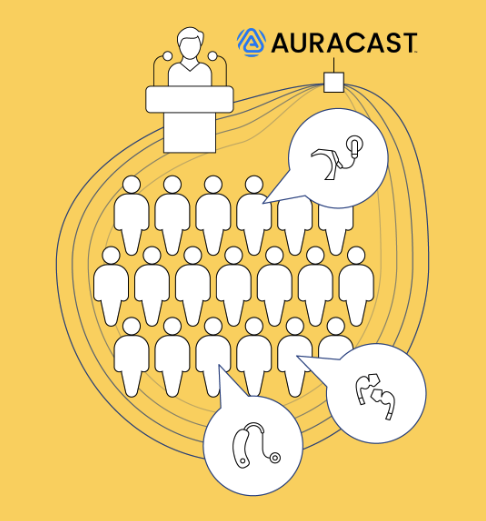
Alongside the classic induction loop, Auracast is emerging—a broadcasting technology based on Bluetooth LE Audio. While an induction loop is mono and reaches up to about 5 kHz, Auracast provides broadband stereo quality and allows an unlimited number of receivers within range to connect. Multilingual support is also easier, as multiple channels can be broadcast simultaneously.
By mid-2026, about sixteen theaters and concert halls in the Netherlands and Belgium have switched to Auracast, and major hearing aid manufacturers support the standard. At the same time, a large portion of visitors still use devices without Auracast. For the coming years, the practical approach is not to replace, but to supplement: the induction loop remains for those with a telecoil, while Auracast is added for those who have already made the switch.
What this means for your next event
Three factors determine whether an assistive listening system at a congress actually works.
First, whether the system has been tested in the actual event space, rather than just in the room next door. Second, whether the signal comes from the correct source, because an induction loop connected to the room's speakers instead of the microphone mix will just amplify the same echo you were trying to eliminate. Third, whether visitors know it exists. A system without signage and without mention in the program is rarely used.
At IFS, in over sixty years of AV practice, we have seen how often accessibility is only brought up on the day itself, when someone in the audience indicates they cannot follow the speaker. At that point, a temporary induction loop can still be installed, but measuring and calibrating takes time that isn't available. Including accessibility in the technical preparation takes a fraction of the effort and results in a program that everyone in the room can follow.
Frequently asked questions about induction loops
What is the difference between a hearing loop and an induction loop?There is no technical difference. Hearing loop, induction loop, audio induction loop, and T-loop are all names for the same system: a cable that transmits sound as a magnetic field to hearing aids equipped with a telecoil. In technical literature, hearing loop is the most common term, and in English, it is referred to as a hearing loop.
Does a hearing loop work with every hearing aid?Only with hearing aids and cochlear implants that have a telecoil and where that T-setting is activated. Many small in-the-ear devices do not have a telecoil. Furthermore, audiologists do not always enable the T-setting by default, so users sometimes have to ask for it themselves. For visitors without a telecoil, neck loops with a separate receiver are available.
Has a hearing loop been mandatory at conferences and events since 2025?Not literally. Since June 28, 2025, the European Accessibility Act has required that products and services with an audio function be compatible with hearing aids, telecoils, and assistive listening systems. The built environment is optional for member states under the directive. However, in practice, assistive listening systems are increasingly being included as a requirement in tenders from governments and international organizations.
Can you rent a hearing loop temporarily for a single conference?Yes. For one-day or multi-day events, a temporary loop is usually installed, for example along the walls of the room or under the carpeting, connected to a mobile hearing loop amplifier. It is important that the system is tested after installation according to IEC 60118-4, as the field strength varies per room due to metal structures and sources of interference.