What exactly is a wrap-up video?
A wrap-up video is a same-day edit: a video production where filming and editing happen in parallel rather than sequentially. The typical length is between one and a half and three minutes. Short enough to maintain the energy, long enough to truly summarize the day. By the end of the day, attendees see their own experience reflected on the big screen, often less than an hour after the final shots were taken.
What it usually includes:
- the arrival and the atmosphere building at the start of the day
- highlights from the core program: speakers, panels, award ceremonies, or a product reveal
- faces from the audience, reactions, conversations, laughter, and focus
- short interview snippets or soundbites from participants
- the party, the drinks, or the informal part of the event
What it does not include: anything that takes a long time. A wrap-up video is not a recording of the keynote or a documentary. It is an emotional summary.
Wrap-up video, aftermovie, or recap—what is the difference?
These terms are often used interchangeably, even though they are different products in practice. Here is a breakdown of the terms.
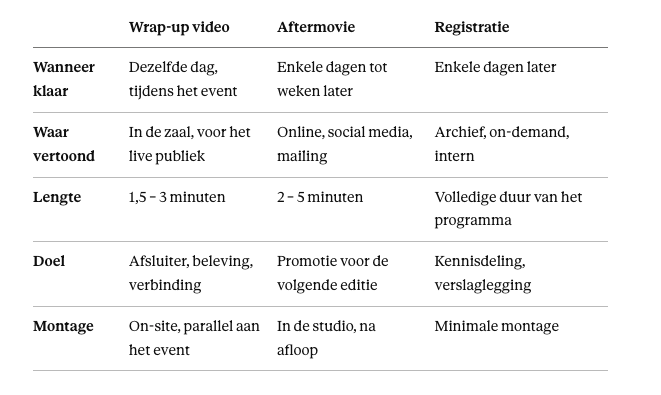
They are not mutually exclusive. In fact, the smartest approach is to repurpose the footage from the wrap-up immediately. You already have the recordings; creating a more extensive aftermovie and individual social clips is then just a matter of building on what you already have.
Why a wrap-up video works
The last five minutes define the memory
Research by figures such as Daniel Kahneman on the so-called peak-end rule shows that people judge an experience afterward based primarily on two moments: the peak and the end. Not on the average of all the hours in between. For an event, that is a significant finding. You can put on a program with strong content, but if the day ends with a thank-you speech in a half-empty room and people searching for the coat check, that is what will stick. A wrap-up video gives you a controlled, powerful closing moment, exactly at the point where it carries the most weight.
The audience sees themselves
This is the part you have to experience to understand. As soon as visitors see themselves, their colleagues, or their friends appear on the screen, a buzz goes through the room. People point, nudge each other, laugh, and film the screen with their phones. A day that was just "an event" until that moment becomes "our day." For organizations with a community, a trade association, a staff association, or a recurring conference, that is exactly the feeling you work for all year long.
Your marketing for next year is ready that same evening
Most aftermovies appear two weeks after the event. By then, the attention has faded, the hashtag is dead, and people scroll right past it. A wrap-up video goes online that same evening, at the moment when participants are still posting themselves and the rest of the industry is wondering what they missed. That difference is huge. You publish within the window where the algorithm, the participants, and the sector are all focused on your event at the same time.
Value that goes beyond the room
What a wrap-up video delivers after the day itself:
- Recruitment for the next edition. Nothing sells a ticket better than the visible enthusiasm from last year.
- Accountability to sponsors and partners. Logos, booths, and mentioned partners in a film that is actually watched is a stronger return on investment than a mention in the program booklet.
- Internal communication. For colleagues who couldn't make it, for management, for the annual report.
- Employer branding and recruitment. Footage of a company event does more on a job page than three paragraphs about company culture.
- Content library. From the same material, you can easily create five to ten separate clips for LinkedIn, Instagram, and your newsletter.

How we create a wrap-up video
The team
The standard setup at IFS Audiovisueel consists of three people, and that division is no coincidence.
Cameraman 1 — atmosphere.
This camera captures the audience, the room, the details, the arrivals, the decor, hands on tables, and laughter over coffee. This is the footage that carries the emotion.
Cameraman 2 — content.
This camera focuses on the program: the speaker on stage, the reveal, the awards ceremony, and short interviews. This is the footage that carries the story.
The editor — on-site.
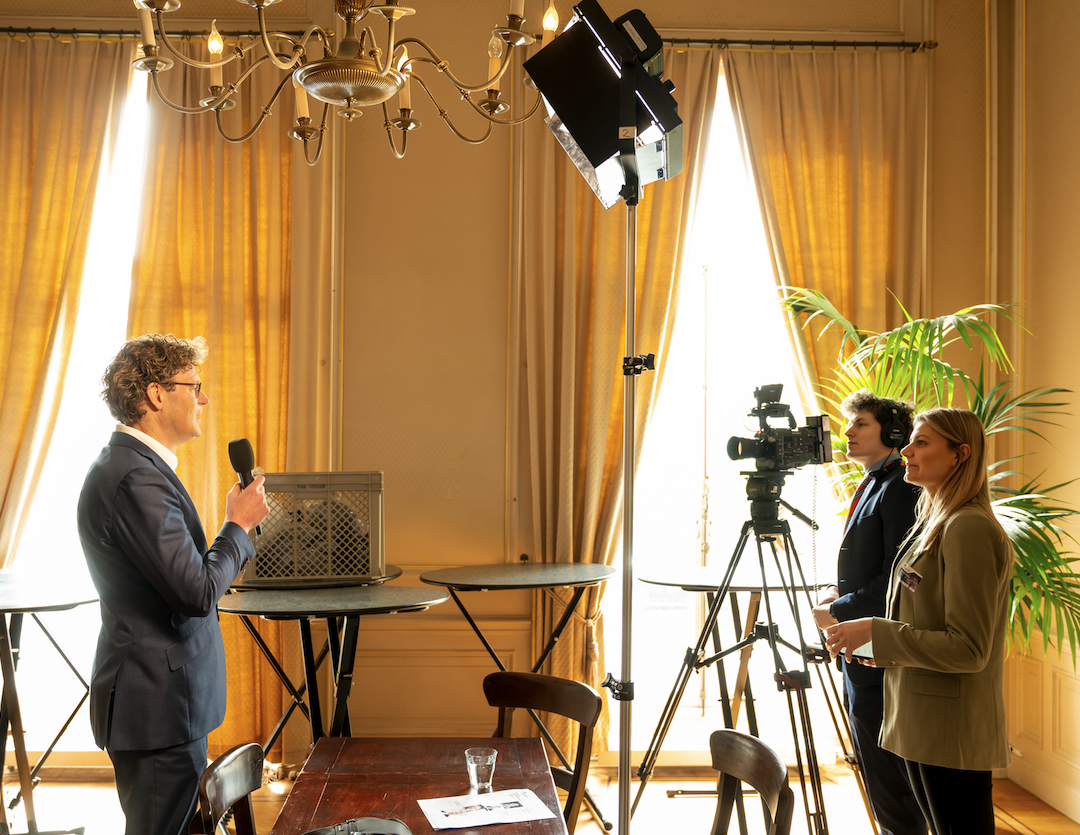
While filming is still underway, the editor is already working in a separate room. Memory cards are brought in throughout the day, ingested, selected, and placed directly onto the timeline.
For larger or more complex productions, we scale up: a third camera for a second room, a drone for outdoor locations, or a second editor if multiple versions need to be delivered simultaneously.
The equipment
What we typically use:
- Cameras with interchangeable lenses, allowing for both wide atmospheric shots and sharp close-ups without needing to change positions
- Gimbals and shoulder rigs for smooth movement throughout the venue
- Wireless microphones for interviews, plus a direct feed from the house soundboard, ensuring the speaker's audio is clean and not affected by the room's acoustics
- On-camera lights or a small set of LED panels for interviews in darker locations
- On-site editing station: laptop or workstation with high-speed storage, card readers, and a calibrated monitor
- A backup drive where all raw footage is copied throughout the day
For the screening itself, we connect to the existing AV setup: a projection screen, an LED wall, or the venue's monitors. An important detail that is often overlooked: the audio. A wrap-up video set to music needs to play through the venue's PA system, not the screen's built-in speakers. The difference in impact is huge.
The day's timeline
This is what a typical shoot day looks like for a conference that starts at 9:00 AM and ends with a wrap-up at 5:00 PM.
- 07:30 – 09:00 Setup, testing cameras and audio, and coordinating with the host and the technical crew. The editor begins building the project foundation: intro, branding, music selection, and title cards.
- 09:00 – 12:00 Filming the opening and the morning program. Around 11:00 AM, the first memory card goes to the editor. The rough structure of the first segment is put together.
- 12:00 – 14:00 Lunch and breakout sessions. This is often the best atmosphere footage of the day: people talking, networking, and laughing. Short interviews are usually recorded during this block.
- 14:00 – 15:30 Afternoon program. The editor catches up and delivers a first rough cut for internal review.
- 15:30 – 16:15 Final shots, including the conclusion of the main program. These go straight into the edit.
- 16:15 – 16:45 Final edit: color correction, audio balancing, adding the final shots, and export.
- 4:45 PM The file is sent to the video technicians to be tested on the screen and the PA system.
- 5:00 PM The video plays. The audience relives the day.
- 5:15 PM The file is available for social media in both landscape and portrait formats.
Music and rights
A point that is frequently overlooked: music in a video you publish must be royalty-free or licensed. You cannot simply use popular tracks by well-known artists—not on YouTube, not on LinkedIn, and strictly speaking, not even in the venue.
We work with production music libraries so that the video can be published without any risk. We prefer to determine the music choice in advance, as it sets the tone for the entire edit. A professional, corporate conference requires something different than a staff party.
.jpg)
What we need from you
A wrap-up video lives or dies by its preparation. Here is what we would like to receive from you in advance and why.
In advance (ideally two to four weeks beforehand)
- The goal of the video. Is this a gift for the attendees, or a sales tool for next year? That changes the edit. A video intended to move the audience is different from one meant to convince a new target group.
- The script or program. We need to know when the reveal is, when the awards ceremony takes place, and when the room is at capacity. We don't get a second chance at those moments.
- A must-have list. Which people, moments, or brands must be captured? The CEO, the person being honored, the main sponsor, the new product. Put it on paper, no matter how brief.
- Brand identity. Logo in vector format, color codes, and the font. Without these files, we can only approximate your brand identity; with them, it’s spot on.
- Music preferences or reference videos. One example of a video that makes you say "that's what I mean" says more than half a page of description.
- Agreements regarding image rights. For a private corporate event, you usually handle this via the registration process or house rules. For a public event, a sign at the entrance notifying attendees of cameras is standard. If you want to be certain, check with your organization's privacy officer—we are happy to help, but the legal basis for processing lies with the organizer.
On the day itself
- A workspace for the editor. A quiet room with a table, power, and preferably a door that closes. No high-traffic areas, no cloakrooms. The editor needs to be able to concentrate for hours at a time.
- Power. A few available power circuits at the editing station and at the camera position.
- One decision-maker. Someone with the authority to approve the final version who is reachable by phone. The most common cause of stress in the final half hour is a review round involving four people who all have different opinions.
- Access. Ensure the crew has access to all areas: backstage, in the breakouts, and at the VIP reception. A cameraman stopped at the door misses the moment.
- A spot in the schedule. The wrap-up video should be scheduled as a program item, with an announcement by the host. Otherwise, it will play while half the room is already at the cloakroom.
When is a wrap-up video most effective?
Conferences and business meetings
The classic use case, and for good reason. A conference day is long and information-dense; by late afternoon, attendees have seen a lot but may lack a clear overview. A wrap-up video distills the day into a cohesive narrative, giving people a sense of having been part of something meaningful. Pair it with the moderator's closing remarks, just before the drinks reception.
Staff parties, anniversaries, and kick-offs
Here, it’s all about recognition. Colleagues seeing themselves dancing, the CEO captured mid-speech, the team appearing on screen together—this is the type of video that circulates on internal channels for months and can be easily repurposed for your next recruitment campaign.
Festivals and public events
For multi-day events, you can use a daily wrap-up: the video from day one plays on the morning of day two, or goes online in the evening to boost attendance for the following day. At a festival, the footage is also immediately reusable as promotional material for the next edition.
Product launches and dealer events
The reveal is the heart of the event. A wrap-up video captures not just the product, but the reaction to it—and that reaction is the most persuasive sales argument you have for partners who couldn't attend.
Trade shows
A trade show day usually consists of many fragmented moments with little cohesion. A daily wrap-up gives your booth team something to share, gives visitors a reason to return, and provides the marketing department with content while the show is still ongoing.
Sporting events and competitions
Award ceremonies, the finish line, the crowd: all the ingredients are already there. Here, the focus is on pace and capturing the decisive moments.
Common mistakes
Scheduling the video too late in the program. If the room is already half empty, you lose the impact entirely. Schedule it before the drinks reception, not after.
No announcement. Without an introduction from the moderator, the audience will think a corporate video is starting and will start talking. One sentence is enough: "We have something for you."
Making it too long. After three minutes, attention drops, no matter how beautiful the footage is. Kill your darlings.
Trying to show everything. Every sponsor, every speaker, every breakout: that turns it into a list instead of a film. Make a choice.
No audio through the venue PA system. See above. This alone halves the impact.
Deciding too late. A wrap-up video conceived three days in advance is technically possible, but it will lack the preparation that makes it great.
What determines the investment?
There is no fixed price because there is no fixed product. These are the factors that determine the costs:
- Team size — one camera operator and an editor is the minimum setup; two cameras are the standard for a full-fledged wrap-up
- Duration of the event — a half-day, a full day, or multiple days
- Number of deliverables — just the version for the venue, or also social media formats, a longer aftermovie, and individual clips
- Additional technology — drone, second room, livestream integration, extra recording points
- Location — travel distance, setup time, availability of an editing suite
- Post-production — animations, subtitles, multilingual versions
Curious about what this means for your event? Get in touch with a brief description of your event, the date, and the number of attendees, and we will provide you with a concrete quote.