Moving heads explained: what they are and why they enhance every event
A good lighting plan largely determines how an event is experienced. Among the fixtures that make a difference, moving heads hold a special place. These dynamic spotlights are the workhorses of modern stages, conference halls, and corporate events, delivering surprisingly rich results with a limited number of fixtures.
In this blog, we explain exactly what a moving head is, what advantages this type offers, why moving heads are particularly valuable at conferences, and what the differences are between wash, spot, and hybrid versions. We will also discuss how to enhance the effect with fog and haze, and how an impressive show doesn't have to be expensive.

What is a moving head?
A moving head is a computer-controlled lighting fixture whose head can move independently. The head rotates horizontally and tilts vertically, allowing the light beam to point in any desired direction. In addition to this movement, almost all light properties are adjustable: color, brightness, beam width, sharpness, and in many cases, projections and patterns.
Control is typically done via a lighting console using the DMX protocol. Each function of the fixture is assigned its own channel, allowing an operator to program movement, color, and effects down to the second. This makes a moving head fundamentally different from a fixed spotlight: a single fixture can fulfill dozens of roles during an evening, from subtle illumination to a dynamic effect during a highlight.
The advantages of moving heads

Why moving heads are important for conferences
At conferences, the focus is often on content, but the presentation of that content determines how professional an organization appears. Moving heads play a key role in this. During a keynote, they provide crisp, focused illumination for the speaker, while effortlessly moving to different positions on stage during a panel discussion.
Furthermore, a conference program features many different moments in one day: plenary sessions, award ceremonies, networking breaks, and sometimes a concluding festive segment. With the same set of fixtures, an operator can switch between business-like, neutral lighting and a dynamic atmosphere, without needing to reconfigure anything. This flexibility is precisely why moving heads are so efficient for corporate events. They adapt the stage visuals to the tone of each program segment, thereby reinforcing the message the organization wishes to convey.
Wash, spot, and hybrid: the main differences
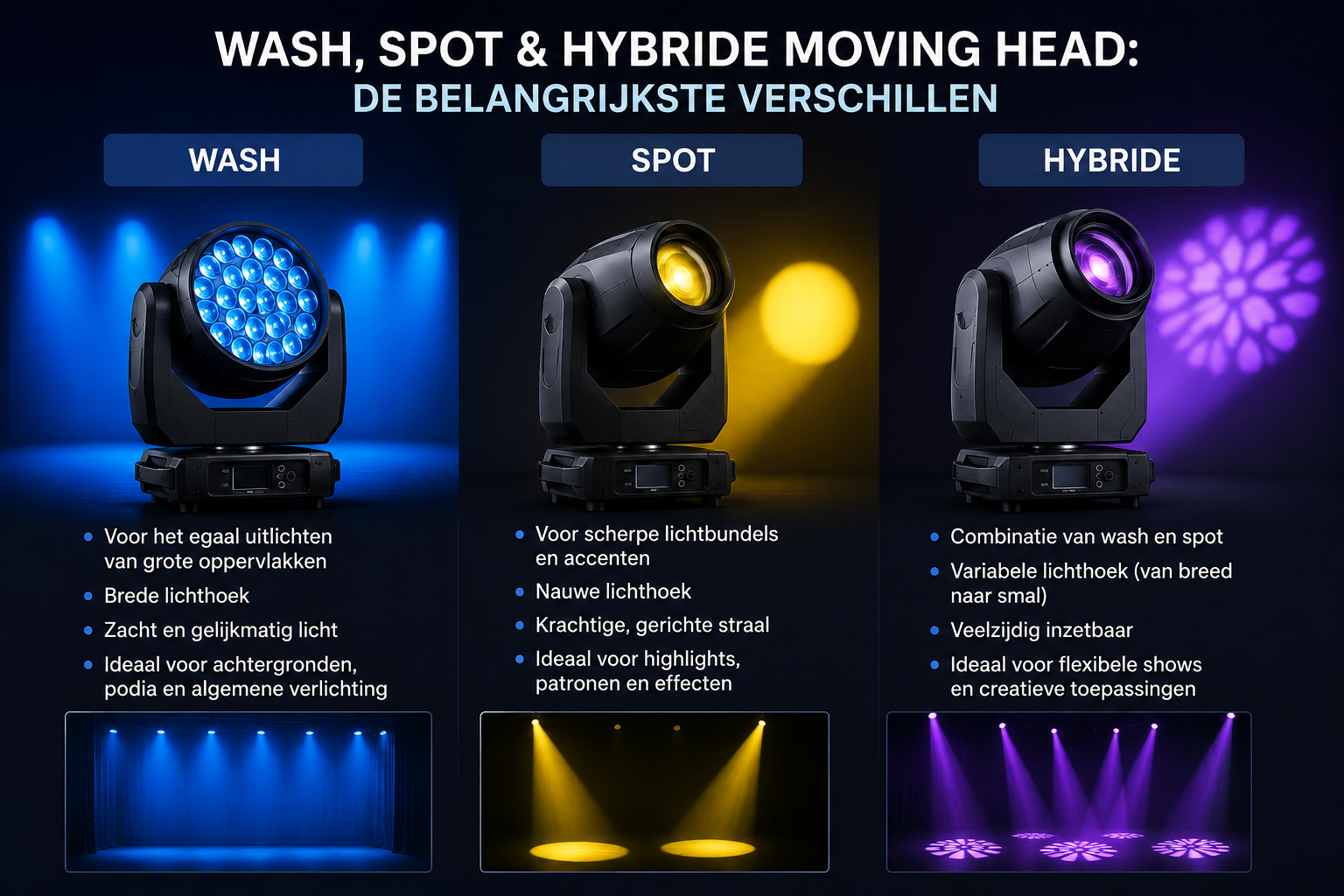
Not every moving head is the same. The three main types differ primarily in the kind of light beam they produce.
A wash moving head produces a wide, soft light beam with smooth edges. This type is designed to evenly illuminate large areas, color a stage, or create an overall atmosphere. Wash fixtures are the foundation for a warm or cool ambiance in a venue.
In contrast, a spot moving head produces a narrow, sharply defined beam. This allows you to precisely illuminate a speaker, an object, or a specific part of the stage. Spots often feature a gobo wheel, which contains templates for projecting patterns, shapes, or logos, and functions like prism and focus for added detail.
A hybrid moving head combines both worlds and often adds a beam function: a very narrow, intense beam of light that is sharply visible in the air. Thanks to the ability to switch between wash, spot, and beam, a single hybrid fixture can be used for both ambiance and accent. For venues that want a lot of variety with a limited number of fixtures, this type is often the most economical choice.
Enhancing the effect with fog and haze
The light beam of a moving head only truly becomes visible when there are particles in the air for the light to reflect off. For this, fog and haze are used. Haze is a fine, even mist that lightly fills the entire space, making beams and colors subtly visible without appearing as smoke. This is ideal for conferences and television recordings.
Fog is denser and visible for a shorter period, and is primarily used for pronounced effects, for example, when a beam cuts through the room. The combination of moving heads with the right amount of haze often makes the difference between a flat-looking stage and an image with depth. A skilled operator carefully doses this, so that the effect enhances the show without making the room feel oppressive.
An impressive show doesn't have to cost a lot
Many organizers believe that an impressive light show requires large budgets. In practice, this is often not the case. Because a single moving head fulfills so many different functions, even a few well-placed fixtures can create a complete picture. The benefit lies not in the number of lights, but in a well-thought-out design and an operator who utilizes the equipment's full potential.
For an average corporate event or conference, a compact set is often sufficient, provided it is used cleverly. Symmetrical placement, a limited but consistent color palette, and a few well-timed effects make a greater impression than an excess of fixtures flashing without cohesion. This way, a professional result remains within reach even with a modest budget.
Projecting your own logo with a glass gobo
A valuable application of spot and hybrid fixtures is logo projection. By having a glass gobo made with your organization's logo on it, a moving head can project that image sharply and in color onto a wall, floor, or stage backdrop. A glass gobo is durable and provides much higher image quality than a metal variant, precisely because fine details and multiple colors are possible.
The effect is subtle yet powerful: visitors immediately see your brand identity upon arrival, and because the moving head can move the image or make it appear at the right moment, it remains flexibly usable throughout the program. For brand experience at an event, this is a simple way to make a professional, polished impression.

In conclusion
Moving heads are versatile, efficient, and surprisingly affordable with a well-thought-out design. Whether it's for a keynote, a conference, or a festive closing event: with the right choice between wash, spot, and hybrid, supported by haze and possibly a glass gobo with your logo, an image is created that enhances the message of your event. Anyone seeking advice on using moving heads for a specific event can always contact IFS Audiovisueel without obligation.