Renting Screens for the 2026 World Cup
The 2026 FIFA World Cup will take place in the United States, Canada, and Mexico, attracting billions of viewers worldwide. For many organizations, this is not only a sporting highlight but also an excellent opportunity to bring employees together, host clients, or organize a public event. Those who rent professional screens and ensure the technology is well-managed will create a memorable experience.
Whether you're planning a corporate party, setting up a public viewing event in a square, or hosting clients in a hospitality environment: the choice and placement of the right display largely determine the success of the event. In this article, we advise you on what to consider when renting screens for the 2026 World Cup and how to optimally utilize audiovisual technology.
Which screen is right for your World Cup event?
Not every screen is suitable for every situation. The choice depends on the location, the number of visitors, lighting conditions, and the desired atmosphere. In the world of AV rental, there are roughly three types of display solutions commonly used for World Cup events.
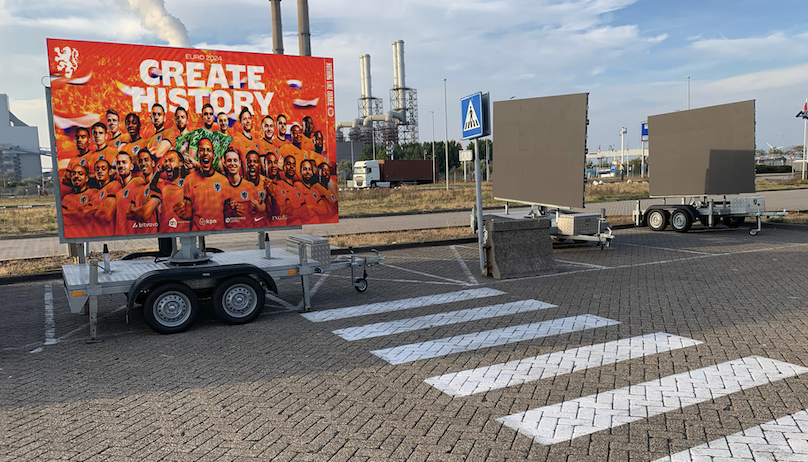
An LED wall is the most striking option: available as an LED trailer or modularly built, very bright and visible from a great distance. This makes it ideal for outdoor locations, large halls, or events with hundreds to thousands of visitors. Its high light output ensures the image remains sharp even in daylight, which is not a luxury during a summer World Cup.
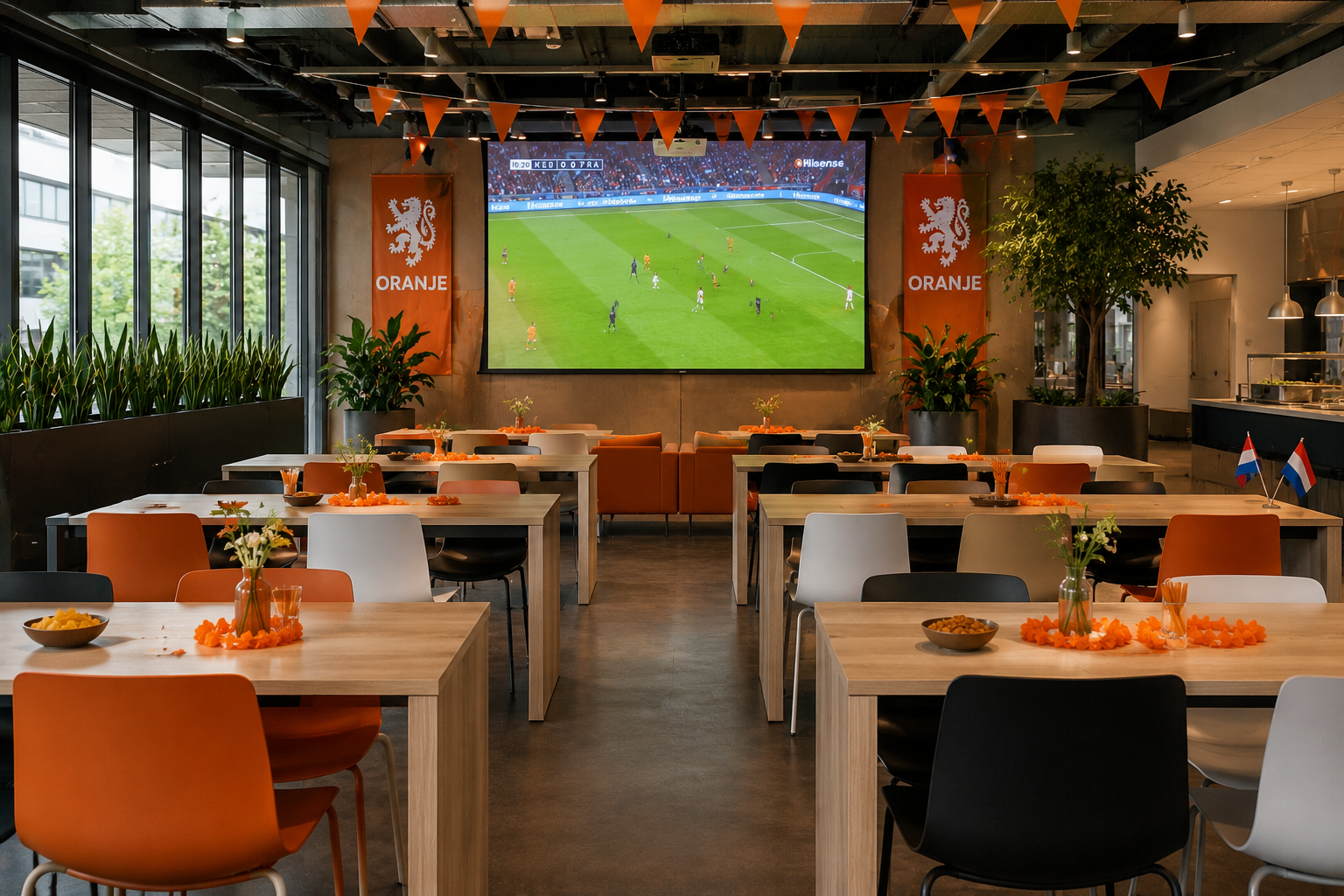
For smaller halls, boardrooms, or VIP areas, projectors or large flatscreens are often the better choice. They offer a warmer image in an enclosed setting and are quicker to set up. For multiple viewing angles in one room, it's wise to use several screens side-by-side, driven from a single source, ensuring everyone always has a good view.
Finally, there are hybrid situations, such as a corporate campus or an inner courtyard, where a combination of indoor displays and a smaller outdoor LED screen offers the most complete solution.
Sound is at least as important as visuals
A common mistake when organizing viewing events is to focus all attention on the visuals and treat sound as an afterthought. In football, commentary, ambient crowd noise, and cheering are essential parts of the experience. Poor sound breaks the tension, no matter how good the picture.
For an outdoor location with many guests, line array speakers are the usual choice: they distribute sound evenly over a large area without people at the back feeling far from the action. Indoors, a carefully calibrated system with sufficient subwoofer support works best, especially in rooms with many reflective surfaces like concrete or glass.
It is wise to always plan and install sound and visuals together. Technical synchronization, the delay between image and sound, is a technical consideration that almost always requires manual adjustment in larger setups. An experienced AV technician from IFS will handle this on-site.
A corporate event centered around the World Cup
Many organizations seize the World Cup as an opportunity to offer employees something extra. This can be as simple as a large screen in the canteen, or it can evolve into a fully catered staff event with catering, live presentations, and interactive elements.
In such cases, it pays to think beyond just the screen. A microphone and a small PA system for a host or presenter, a video recording of the meeting, or a livestream for employees watching remotely: all these elements can be technically well combined.
Companies operating internationally can also use the World Cup as an opportunity to have employees worldwide watch simultaneously via a livestream connection. You can then cheer together with all locations and see each other via a stream. With the right equipment and a stable internet connection on-site, this is technically feasible.
Watching a public match? Technology and permits go hand in hand
Anyone organizing a public viewing event must contend not only with the technical aspects but also with the surrounding logistics. Permits, BUMA/Stemra rights for public broadcasting of matches, power supply, and weather conditions are all factors that need to be arranged in a timely manner.
From a technical perspective, a thorough site survey is always the first step. This involves assessing available power, cable routes, potential obstructions for visuals, and sound distribution in relation to local residents. A technical plan on paper prevents surprises on the day itself.
Furthermore, for public events, the equipment must be able to withstand varying weather conditions. Weather-resistant speakers and cable pass-throughs are not a luxury, but essential components of a robust outdoor setup.

Hospitality and customer retention during the World Cup
A third application that is increasingly common at major sporting events is the use of AV technology in a hospitality context. Inviting clients to watch a match together is an effective way to maintain relationships, especially if the environment is professionally set up.
Imagine a private room with a large screen, sharp image, good sound, and a polished presentation. The technology fades into the background, and the focus shifts entirely to the experience and the conversation. It's precisely in these environments that the quality of the AV setup becomes apparent: flickering, delays, or a blurry image are disruptive and undermine the professional image your organization aims to project.
For hospitality setups, also ensure a reliable signal source. Satellite or cable reception is more stable than streaming via a consumer subscription, especially in locations with limited bandwidth.
Planning ahead is key
The 2026 World Cup starts in June. Anyone looking to rent screens, sound equipment, and related technology would be wise to contact us well in advance. During periods surrounding major sporting events, demand for displays and sound systems is high, and the availability of popular equipment cannot be guaranteed if you wait too long.
A timely request also allows for thorough preparation: a site visit, a technical plan, and a test setup are all steps that contribute to a smoothly run event. The sooner the technical aspects are finalized, the more time remains for the organizational side of the event.
IFS Audiovisueel helps design the right technical setup, from a simple screen solution to a complete AV installation with video, sound, recording, and live connections.
Contact us to discuss the possibilities.